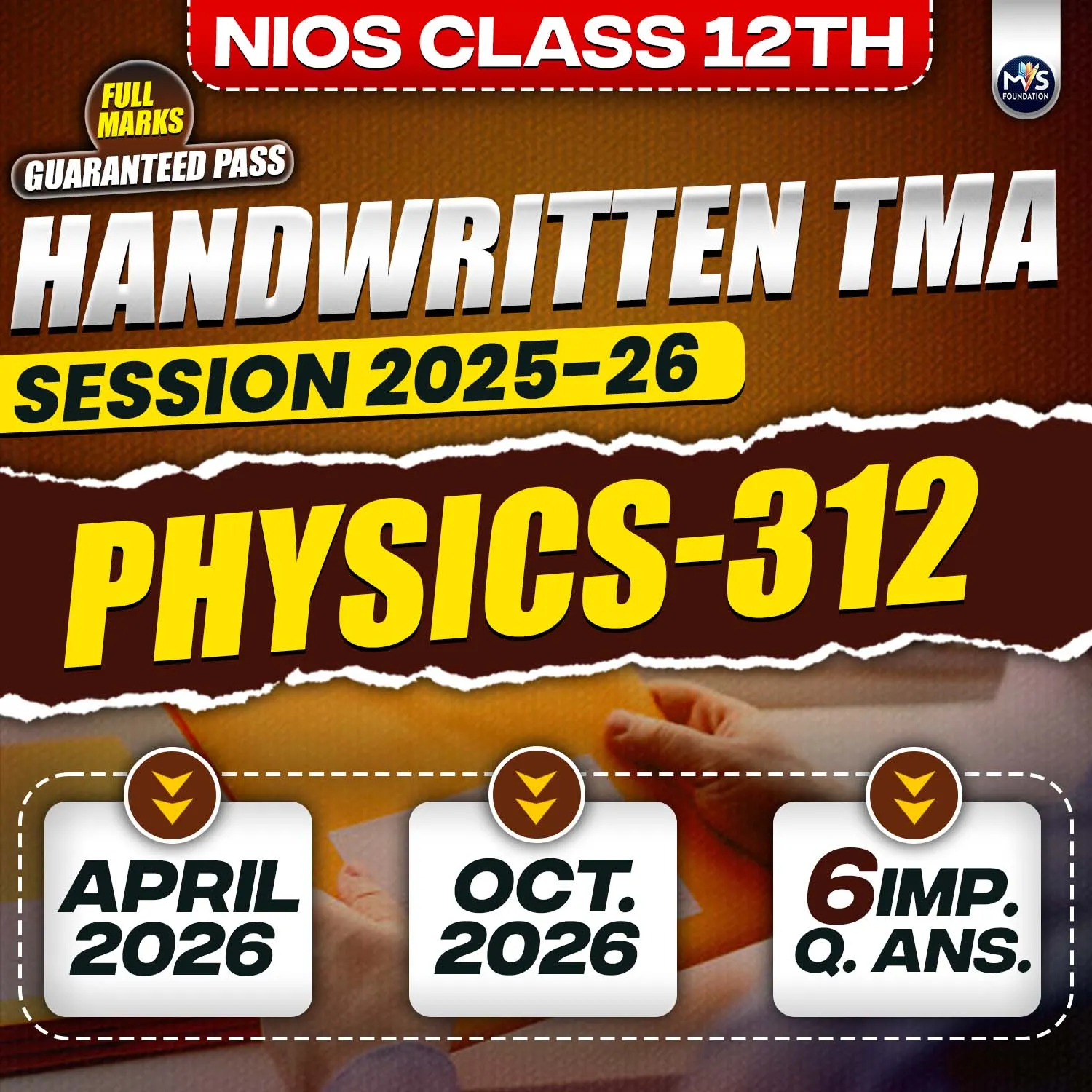
Boost Your Marks with High-Quality Handwritten TMA Answers
Applicable for: Apr/Oct 2026 Exams
- Expert-prepared, error-free Hindi / English Handwritten TMA
- Well-structured answers to help you score maximum marks
- Includes complete project work for 100% submission readiness
Why Choose Our NIOS Handwritten Solved TMA?
• Expertly Written – Prepared by experienced NIOS teachers
• Neat & Clean Handwriting – Easy for examiners to read and evaluate
• A4 Size & Proper Format – Follows NIOS guidelines strictly
• High Scoring Answers – Pointwise, accurate, and within word limit
• Ready to Submit – Just Download and upload to the NIOS portal
• Hindi Medium – Answers provided in clear and accurate Hindi..
• Updated for 2025–26 – Based on the latest syllabus and TMA questions
Questions Covered in This PDF:
1. Answer any one of the following questions in about 40-60 words.
(b) The steel ball is subjected to increasing pressure all around it. This pressure causes the ball to shrink slightly and develops stress inside it.
The data showing normal stress developed inside the steel ball corresponding to the volumetric strain is tabulated below:
2. Answer any one of the following questions in about 40-60 words.
(a) Find the degree of freedom, Cp, Cv and total energy of a He molecule at 300 K temperature.
3. Answer any one of the following questions in about 40-60 words.
(b) The communication capacity of visible light in an optical fibre is about 100,000 times greater than that of a typical microwave in a metallic conductor. Explain.
4. Answer any one of the following questions in about 100 to 150 words.
Q4 (a) Consider an oscillatory system consisting of two blocks of masses m1 = 3 kg and m2 = 2 kg, connected by a massless spring with a spring constant k = 200 N/m. The blocks are pulled apart with equal forces of magnitude F = 5 N each and then
released. Calculate the angular frequency of each mass. Assume that the system moves on a smooth horizontal surface, and the center of mass remains stationary.
5. Answer any one of the following questions in about 100 to 150 words.
(a) An object is placed at a distance of 6 cm from the first focus of a convex lens. The image is formed 24 cm away from the other focus.
(i) Find the focal length of the lens.
(ii) If the lens is made of glass with a refractive index of 1.5, calculate the radius of curvature of the lens surfaces (Assume it is a bi-convex lens with equal radii).
(iii) If an object is placed 36 cm from the lens, find the image distance.
(iv) What will be the magnification of the image formed in the above case? Is the image real or virtual?
6. Prepare any one project out of the given below:
Q 6 (a) Docking is the process of connecting two satellites in space, where one (the chaser) approaches and attaches to another (the target). In its Space Docking Experiment (SpaDeX) mission, ISRO successfully docked two small spacecraft, Spacecraft A and Spacecraft B, each weighing about 220 kg. These satellites were orbiting Earth at around 28,800 km/h at an altitude of approximately 500 km.
During docking, their relative speed was gradually reduced to 0.036 km/h when they were 3 meters apart, ensuring a smooth connection.
Using the data given in the above paragraph, answer the following:
(i) Find the time taken by Spacecraft A (Chaser) to approach Spacecraft B (target) when they are 3 meters apart. (Assuming relative speed of 0.036 km/h to be constant during this approach).
(ii) Determine the value of the acceleration due to gravity (g) at 500 km altitude.
(iii) Estimate the orbital period of either satellite.
(iv) Calculate the gravitational potential energy of (Earth + Spacecraft A) system.
(v) Find the angular momentum of either satellite in S.I. as well as in c.g.s units.
(vi) The SpaDeX satellites were launched on a polar orbit using the Polar Satellite Launch Vehicle (PSLV) by ISRO to demonstrate spacecraft docking technology. List other applications of polar orbits and explain when they are termed as sun synchronous.
(Take radius of earth = 6.4 X 10⁶ m and mass of earth = 6 X 1024 kg)
NOTE- You will get the answers of all these questions after purchasing the PDF.
इन सभी प्रश्नो के उत्तर आपको PDF लेने के बाद मिल जायेंगे |
Most Important Facts relating to TMA:
• 20% Weightage – TMA carries 20% marks in the final result.
• Submission Dates – Last date: 31 Jan 2026 (April Exam), 31 July 2026 (October Exam).
• Prepared by Experts – Answers written by experienced NIOS teachers.
• As per NIOS Guidelines – Follows word limit, format, and latest syllabus.
• Improves Final Marks – Well-written TMA helps you score better overall.
How to Submit?
• You will get a Handwritten PDF after Payment.
• Login Student portal on NIOS Website and Click on Upload TMA.
• Upload on the NIOS student portal before the deadline
How to Buy?
Click on the "BUY NOW" button to get instant access to your PDF.
Secure your best marks today.
Disclaimer:
We provide solved TMA and Practical Files for NIOS students prepared by experienced and qualified teachers. All solutions are written with accurate content and neat presentation to help students score better marks. However, final marks are entirely subject to the evaluation and discretion of NIOS examiners. We do not guarantee full marks or specific grades, as assessment standards may vary from teacher to teacher. Our materials are intended for academic assistance and reference purposes only.


 By Manish Verma